Machined Plates Play It Again Sports
Lapping is a machining process in which two surfaces are rubbed together with an abrasive between them, past hand motion or using a machine.
This tin can take two forms. The first type of lapping (traditionally called grinding), involves rubbing a brittle material such equally drinking glass against a surface such as iron or glass itself (too known equally the "lap" or grinding tool) with an abrasive such as aluminum oxide, jeweller's rouge, optician's rouge, emery, silicon carbide, diamond, etc., between them. This produces microscopic conchoidal fractures as the abrasive rolls about between the two surfaces and removes material from both.
The other form of lapping involves a softer material such as pitch or a ceramic for the lap, which is "charged" with the annoying. The lap is then used to cut a harder material—the workpiece. The abrasive embeds inside the softer material, which holds information technology and permits it to score across and cut the harder cloth. Taken to a finer limit, this will produce a polished surface such equally with a polishing material on an automobile, or a polishing cloth or polishing pitch upon glass or steel.
Taken to the ultimate limit, with the aid of accurate interferometry and specialized polishing machines or skilled paw polishing, lensmakers tin can produce surfaces that are flat to better than xxx nanometers. This is one twentieth of the wavelength of lite from the commonly used 632.8 nm helium neon laser light source. Surfaces this apartment can be molecularly bonded (optically contacted) by bringing them together under the correct conditions. (This is not the aforementioned as the wringing issue of Johansson blocks, although it is like).
Performance [edit]

Small lapping plate made of cast iron
A slice of atomic number 82 may be used as the lap, charged with emery, and used to cut a slice of hardened steel. The small-scale plate shown in the beginning moving picture is a mitt lapping plate. That item plate is fabricated of bandage atomic number 26. In apply, a slurry of emery powder would be spread on the plate and the workpiece simply rubbed against the plate, usually in a "effigy-eight" pattern.

The second picture is of a commercially bachelor lapping machine. The lap or lapping plate in this machine is 30 cm (12 in) in diameter, about the smallest size bachelor commercially. At the other cease of the size spectrum, machines with two.4-to-iii.0-metre-diameter (8 to 10 ft) plates are non uncommon, and systems with tables 9 k (30 ft) in diameter take been synthetic. Referring to the 2nd picture once more, the lap is the big circular disk on the tiptop of the motorcar. On top of the lap are two rings. The workpiece would be placed inside one of these rings. A weight would then exist placed on pinnacle of the workpiece. The weights can too be seen in the picture along with two cobweb spacer disks that are used to even the load.
In functioning, the rings stay in one location as the lapping plate rotates below them. In this machine, a small slurry pump tin be seen at the side, this pump feeds abrasive slurry onto the rotating lapping plate.

Logitech lapping machine and retentivity jig
When there is a requirement to lap very small specimens (from 75 mm (iii in) down to a few millimetres), a lapping jig tin can be used to hold the cloth while it is lapped (come across Image 3, Lapping machine and retentiveness jig). A jig allows precise control of the orientation of the specimen to the lapping plate and fine adjustment of the load applied to the specimen during the material removal procedure. Due to the dimensions of such small samples, traditional loads and weights are too heavy as they would destroy delicate materials. The jig sits in a cradle on top of the lapping plate and the dial on the front of the jig indicates the amount of material removed from the specimen.
Two-piece lapping [edit]
Where the mating of the two surfaces is more important than the flatness, the two pieces can be lapped together. The principle is that the protrusions on one surface will both abrade and be abraded by the protrusions on the other, resulting in 2 surfaces evolving towards some mutual shape (not necessarily perfectly flat), separated by a distance determined by the average size of the annoying particles, with a surface roughness adamant by the variation in the abrasive size. This yields closeness-of-fit results comparable to that of two accurately-flat pieces, without quite the aforementioned caste of testing required for the latter.
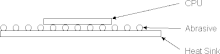
Schematic of two-piece lapping
One complexity in two-slice lapping is the need to ensure that neither piece flexes or is deformed during the process. Equally the pieces are moved past each other, office of each (some area near the edge) will be unsupported for some fraction of the rubbing movement. If one slice flexes due to this lack of support, the edges of the reverse piece will tend to dig depressions into it a short distance in from the edge, and the edges of the reverse piece are heavily abraded by the same activeness - the lapping procedure assumes roughly equal pressure distribution across the whole surface at all times, and volition neglect in this way if the workpiece itself deforms under that pressure.
Accuracy and surface roughness [edit]
Lapping tin can exist used to obtain a specific surface roughness; it is likewise used to obtain very authentic surfaces, commonly very flat surfaces. Surface roughness and surface flatness are two quite dissimilar concepts.
A typical range of surface roughness that can exist obtained without resorting to special equipment would fall in the range of 1 to 30 units Ra (average roughness), usually microinches.
Surface accuracy or flatness is usually measured in helium low-cal bands (HLB), one HLB measuring nigh 280 nm (1.i×ten−5 in). Again, without resort to special equipment accuracies of 1 to 3 HLB are typical. Though flatness is the almost common goal of lapping, the procedure is besides used to obtain other configurations such as a concave or convex surface.
Measurement [edit]
Flatness [edit]
The easiest method for measuring flatness is with a tiptop approximate positioned on a surface plate. Note that you must ready the part on three stands and find the minimum variation while adjusting them, but placing the part on the surface plate and using a dial indicator to find TIR on the opposite side of the office measures parallelism. Flatness is more hands measured with a co-ordinate measuring machine. But neither of these methods can mensurate flatness more than accurately than about 2.5 μm (9.viii×10−5 in).

Optical flats in a wooden case
Another method that is commonly used with lapped parts is the reflection and interference of monochromatic light.[i] A monochromatic calorie-free source and an optical apartment are all that are needed. The optical flat – which is a piece of transparent glass that has itself been lapped and polished on one or both sides – is placed on the lapped surface. The monochromatic lite is then shone down through the glass. The low-cal volition laissez passer through the glass and reflect off the workpiece. As the light reflects in the gap between the workpiece and the polished surface of the glass, the light will interfere with itself creating lite and dark fringes called Newton'southward rings. Each fringe – or band – represents a change of one one-half wavelength in the width of the gap between the glass and the workpiece. The light bands display a contour map of the surface of the workpiece and tin be readily interpreted for flatness. In the past the low-cal source would accept been provided past a helium-neon lamp or tube, using the neon 632.8nm line,[ commendation needed ]or mercury vapor green line but nowadays a more than mutual source of monochromatic low-cal is the low pressure sodium lamp.[ citation needed ] Today, Laser diodes and LEDs are used, both existence inexpensive and narrow-band lite sources. With semiconductor light sources, bluish is an option, having a smaller wavelength than ruby.
For a more thorough description of the physics behind this measurement technique, see interference.
Roughness [edit]
Surface roughness is defined by the minute variations in height of the surface of a given material or workpiece. The private variances of the peaks and valleys are averaged (Ra value), or quantified by the largest difference from meridian-to-valley (Rz). Roughness is usually expressed in microns. A surface that exhibits an Ra of viii consists of peaks and valleys that average no more eight µm over a given altitude. Roughness may exist also measured by comparing the surface of the workpiece to a known sample. Calibration samples are available unremarkably sold in a set up and unremarkably covering the typical range of machining operations from about 125 µm Ra to 1 µm Ra.
Surface roughness is measured with a profilometer, an instrument that measures the minute variations in height of the surface of a workpiece.
See also [edit]
- Flat honing – a variation of very fine grinding
- Surface metrology – for a brief description of these devices
References [edit]
- ^ English, R. E. (1953). "Optical Flats". In Ingalls, Albert K. (ed.). Apprentice Telescope Making, Volume 3. Scientific American. pp. 156–162.
External links [edit]
- Marker Irvin, Engis Corporation (February 2011). "Diamond Lapping and Lapping Plate Control" (PDF). Production Machining. Gardner Publications. Archived from the original (PDF) on 2012-04-25. Retrieved 2011-xi-17 .
Source: https://en.wikipedia.org/wiki/Lapping

Yorum Gönder for "Machined Plates Play It Again Sports"